
When business leaders talk about “governing data,” it often leads to a confusion between Information Governance (IG) and Data Governance (DG), but the two are not the same thing. To design an effective program, you must understand their differences, overlaps, and why both matter.
Information Governance vs Data Governance
Why It Matters
Consider the statistics, according to Precisely’s 2025 planning insights, 71% of organisations now claim to have a data governance program, up from 60% in 2023, leading to improved data analytics and insights (58%), improved data quality (58%) and increased collaboration (57%). On the flip side, the Independent data maturity survey by Carruthers & Jackson found that 39% of companies still have little or no formal data governance frameworks.
These statistics do not only show growth in adoption, it also reveals clear gaps in maturity and implementation. Meanwhile, the cost of mismanaging data is steep. IBM’s Cost of a Data Breach report in 2024 revealed that data breaches across multi-environment setups (cloud, on-premise, hybrid) is estimated at over USD 5 million and take a long time to contain (about 283 days). In fact, 86% of customer are unwilling to do business with a company that has recently experienced data breach according to Data Centre Magazine.
These are the REAL pressures behind the driving force for both data and information governance, but misrepresenting them can dilute their impact.
Defining the Two: What’s the Difference?
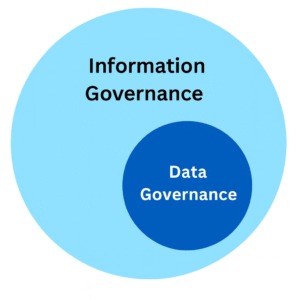
Data Governance primarily focuses on the technical and operational aspects of managing data. It addresses the issues about data quality, data lineage, data ownership, classification, and the policies that influences the use of data, how it can be accessed, and maintained. In summary, it is all about controlling the data itself.
On the other hand, Information Governance is a broader subject. It encompasses the business, legal, and risk dimensions of information, it is not just about the data, but also records, documents, emails, and other forms of organisational knowledge. IG seeks to manage information responsibly in line with privacy, compliance, retention, risk, and value.
Now, here’s the difference, while Data Governance addresses what the data is and how it flows. Information Governance is about why the information exists, who’s responsible for it, and what the lifecycle of that information looks like from creation to disposition.
A Practical Scenario to Illustrate
Consider this Scenario:
Imagine a rapidly-growing healthcare company in the UK, “MediBoost,” managing patient data, email exchanges, clinical records, and research documents.
• MediBoost’s Data Governance team is concerned with ensuring that the patient data is clean, that each data field is stored in the correct format, and that only the right personnel can modify certain high-risk fields. They set up rules to prevent duplicates, manage data lineage, and classify records (e.g., “sensitive,” “non-sensitive”).
• However, the Information Governance role boarders around policies; when to archive or delete clinical records, how long research documents should be retained for legal and ethical reasons, who in leadership must sign off on data access, and how to protect patient confidentiality in compliance with health regulations.
Information Governance operates at a level higher than Data Governance, connecting data policies to risk management, legal compliance, and business goals. While it is possible for MediBoost to have excellent data quality without IG, it will still be highly vulnerable to litigation, non-compliance, or inefficient record-keeping.
Why You Need Both
1. Risk Mitigation: Data Governance ensures the technical reliability of data. IG ensures that the data is used, stored, and disposed of in the proper way to mitigates legal, compliance, and reputational risk.
2. Efficiency and Value: Proper Data Governance system improves data quality and usability. Research by Gitnux shows that 72% of organisations believe data governance improves data quality. At the same time, IG enhances the value of information as a corporate asset, ensuring that critical records are available when needed, and junk is safely discarded.
3. Strategic Alignment: Information Governance aligns information strategy with business objectives, regulations, and record-keeping laws, while Data Governance sets the foundation by ensuring trustworthy data.
In conclusion, Data Governance is the framework that governs the operations of raw data. While Information Governance is the strategy that governs the entire information lifecycle. The ability to distinguish them is far beyond semantic, it’s foundational for developing programs that are both technically sound legal.
Focusing only on data governance, will put you at risk of technical excellence with huge strategic gaps. On the other hand, focusing on information governance, may lead to lack of the data discipline to execute efficiently. Therefore, to succeed, organisations must invest in both and ensure that the teams communicate and collaborate effectively.